A more flexible way through the Building Code: how Performance Solutions can pull cost out of a project
Author
Co-Perform
Published
June 2026
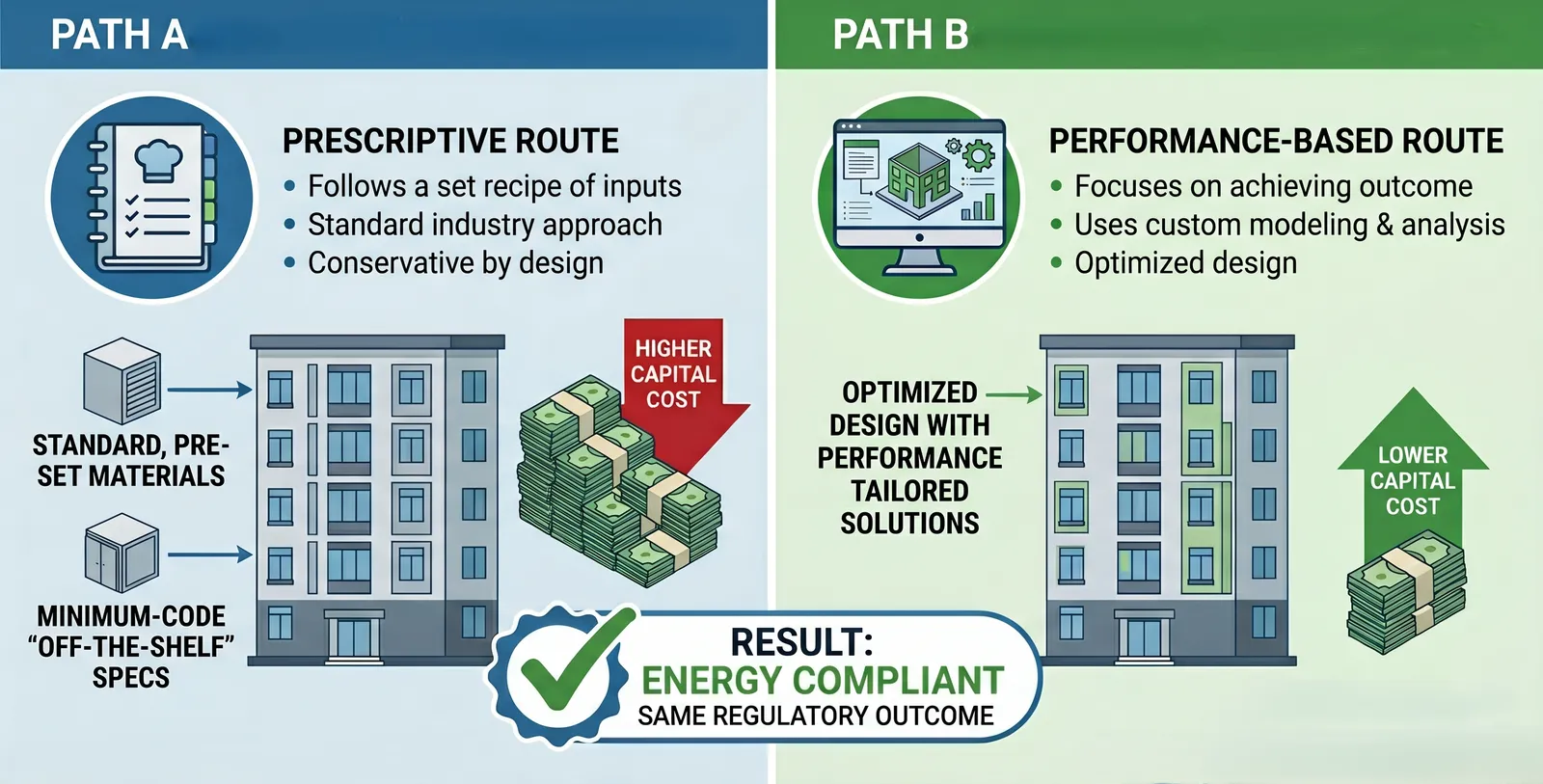
Two projects can land at the same energy compliance outcome under the National Construction Code. One can cost the developer materially more to get there than the other. The difference often in which path through the Code the team chose to take.
Most projects take the same one. It’s well understood, and on a straightforward building it’s the right call. But the Code offers a second path, and on the right project it can give you a much more flexible way to comply and pull real cost out without changing the performance outcome at all.
Compliance is part of the cost squeeze
Construction costs are climbing again. Rider Levett Bucknall has the rise at 4 to 6 per cent across major Australian cities in 2026, we have heard predictions up to 3 times that, with Melbourne under particular pressure from labour shortages and costs that were already high to begin with. Industry leaders heading into 2026 named cost management as their dominant concern. In Victoria, private projects are stalling on feasibility because revenues can’t keep up with build costs.
Energy compliance is part of that pressure. The standard route through Section J, the Deemed to Satisfy method, is conservative by design. It tends to add cost to a project. Higher-performance glazing. Different glass on different elevations. Insulation builds that complicate and add cost to walls.
A lot of teams accept that as the cost of doing business.
It doesn’t have to be.
The Code already gives you a choice
The National Construction Code is what’s called a performance-based code. It states the performance the building has to deliver: manage a certain level of greenhouse gas emissions, achieve a certain level of thermal comfort for the occupants, and then it offers two routes for proving you’ve met that performance.
The first route is Deemed to Satisfy. The Code spells out a recipe of inputs, and if you follow it, you’re deemed compliant.
The second route is a Performance Solution. We say to the Code: we know what you’ve asked for, and we can meet that same requirement by doing something else. Then we prove it.
Both routes are equally valid. The performance-based pathway isn’t experimental; fire engineers, large parts of the rest of the Code have been doing performance solutions for decades. In fire engineering, it’s a matter of course. In ESD work, apart from J1V3, it’s still the road less travelled.
Why the standard route can cost more
The Deemed to Satisfy provisions are limited by what the Code chose to include in the recipe. The list is narrower than the list of things that affect a building’s energy performance, which means project teams are often forced into expensive solutions when cheaper, equally effective ones exist outside the prescribed list.
A few examples of what’s in our toolkit that Deemed to Satisfy doesn’t credit.
Improved airtightness. When a building leaks less air, you don’t have to heat and cool air that’s coming in unwanted (without your say-so). The energy savings are real and measurable, but again, they’re outside what Deemed to Satisfy looks at.
Improved internal blinds to reflect solar radiation and reduce surface temperatures and improve thermal comfort.
Changes in floor coverings to improve the benefits of thermal mass.
Ceiling fans, better blinds, sophisticated assessment of solar-reflective glazing. This is where the thermal comfort piece comes in. The Code is not only concerned with energy performance and greenhouse gas emissions, the Code also regulates the level of thermal comfort for the people inside the building.
A lot of the problems we see from Deemed to Satisfy solutions are thermal comfort problems, not energy problems. Ceiling fans improve summer comfort and extend the comfort range upward in summer. Solar-reflective blinds reduce the radiant heat coming through windows. Both improve how the building feels to be in, and both can be brought into a Performance Solution.
None of these are unusual. They’re just outside the Deemed to Satisfy list.
How we do this
A Performance Solution starts with engineering reasoning. We think in first principles terms about why a particular intervention on a building should save energy. We might say, from first principles, we know thermal mass will improve the feeling of comfort in a space, and it should reduce the energy needed to keep that space comfortable. We know that because we’ve spent enough years doing this work to know it.
That’s a hypothesis. The next step is to test it. We simulate the proposed design using the same energy modelling tools the Code itself relies on, that allows us to set a compliant facade specification. We assess that facade with our more sophisticated modelling and we make changes to improve the design and save costs. If the modelling shows the building meets or beats the performance requirement, that’s the basis of the Performance Solution and we quantify the actual saving. An accredited engineer signs off. The building surveyor approves it. The project complies by a different route to the same destination.
Two things are worth noting. This isn’t work everyone can do, it requires specific qualifications to sign off on, and it requires experience and good judgement. The pathway has been misused in the past, and the peak bodies overseeing the Code’s energy provisions have taken note. We are totally professional and accurate in what we claim. We don’t sign off on a design we can’t defend in front of a building surveyor or a peer reviewer. We’d always find the genuine number than the marketable one.
What this can look like on a project
Consider a project where the standard NATHERS pathway is driving a high-performance and difficult glazing specification across the entire facade. A Performance Solution might test whether you could use a simpler, cheaper glazing, potentially far cheaper, and demonstrate, through modelling, that the building still meets the energy and thermal comfort performance the Code requires.
If that worked, the saving could be in the order of 3% of the construction contract. On a $50 million project, that’s $1.5 million. That number gets a facade contractor’s attention and changes the cost picture of the whole project.
The savings won’t always land there. Sometimes the gap between what Deemed to Satisfy is specifying and what the building genuinely needs is modest, and the saving comes out small. Sometimes it’s substantial. The work is finding where the gap lives, and being honest about it when we get there.
The conversation we’d like to have
We want to help projects move forward in the cost environment the industry is in right now. Performance Solutions are one of the genuine levers we have for doing that. It’s a flexible way to meet the Code’s requirements by a route that may not have been considered, and that may suit your project better than the standard one.
If you’ve got a project where the energy compliance specification is starting to feel like it’s costing more than it should, we’d be happy to have that conversation and see where cost might come out of it.
Ready to build with clarity? Get in touch.